
 Search

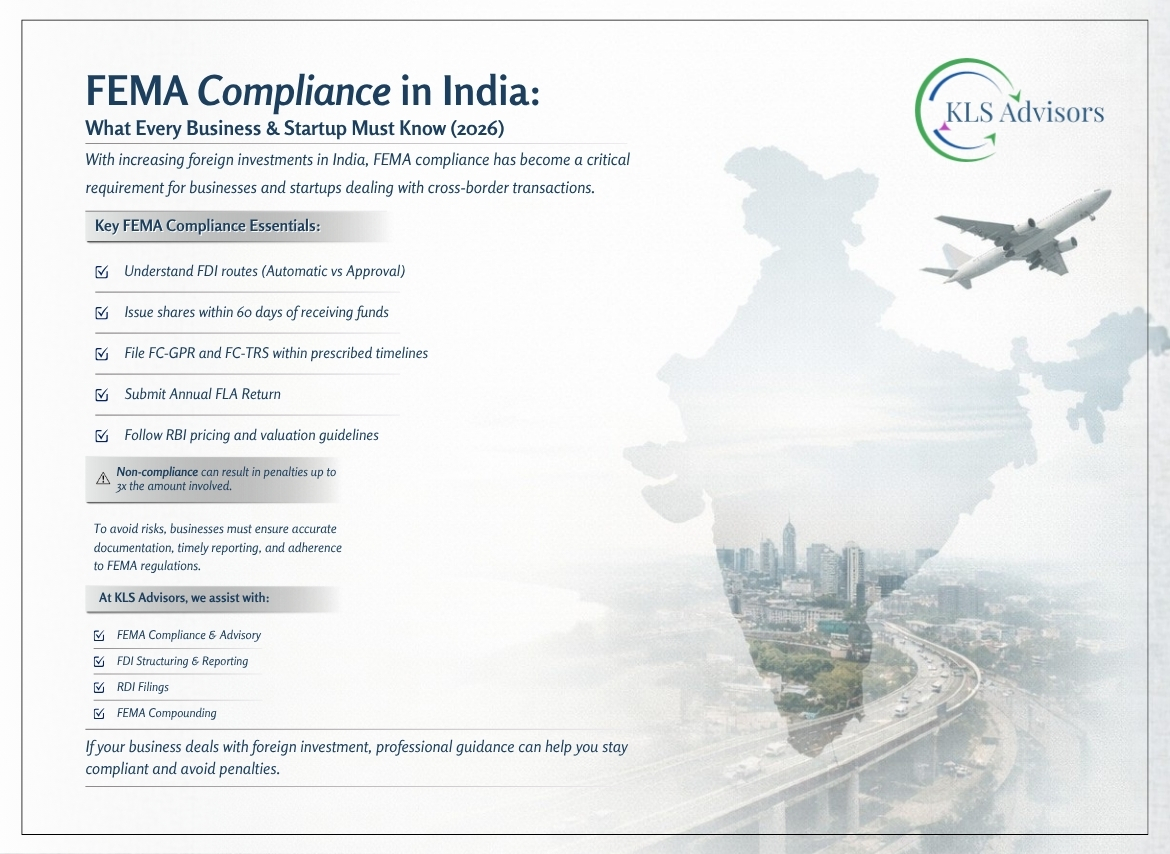
Global expansion and foreign investment have become common for Indian startups and businesses. However, dealing with cross-border transactions requires strict compliance with India’s foreign exchange laws.
This is where FEMA compliance becomes critical.
In this complete guide, we will explain everything you need to know about FEMA compliance in India, including FDI rules, reporting requirements, penalties, and compounding procedures.
What is FEMA?
The Foreign Exchange Management Act, 1999 (FEMA) governs foreign exchange transactions in India.
It is administered by the Reserve Bank of India and enforced by the Directorate of Enforcement.
FEMA regulates:
- Foreign investments (FDI & ODI)
- Cross-border payments
- Import and export transactions
- Foreign currency dealings
Objectives of FEMA
FEMA aims to:
- Facilitate external trade and payments
- Promote orderly development of foreign exchange market
- Regulate foreign investments
- Maintain financial stability
Unlike older laws, FEMA focuses more on management rather than strict control.
What is FEMA Compliance?
FEMA compliance refers to following all rules, regulations, and reporting requirements related to foreign exchange transactions.
Businesses must ensure:
- Proper documentation
- Timely reporting to RBI
- Adherence to FDI guidelines
- Compliance with sectoral caps
Failure to comply may result in penalties.
Who Needs to Comply with FEMA?
FEMA applies to:
- Indian companies receiving foreign investment
- Startups raising funds from overseas investors
- Exporters and importers
- Foreign companies operating in India
- NRIs investing in India
Types of Foreign Investments in India
1. Foreign Direct Investment (FDI)
FDI refers to investment made by foreign entities in Indian companies.
Routes of FDI
Automatic Route
No prior approval required from RBI or government.
Approval Route
Requires approval from the Government of India.
2. Overseas Direct Investment (ODI)
ODI refers to investments made by Indian entities in foreign companies.
FEMA Compliance for Startups
Startups receiving foreign funding must follow FEMA guidelines.
Key Compliance Requirements
- Issue shares within 60 days of receiving funds
- File FCGPR form with RBI
- Maintain valuation reports
- Follow pricing guidelines
Non-compliance can lead to penalties.
FEMA Reporting Requirements
Proper reporting is essential under FEMA.
Common FEMA Forms
1. FC-GPR
Filed when shares are issued to foreign investors.
2. FC-TRS
Filed for transfer of shares between residents and non-residents.
3. ODI Forms
Filed for overseas investments.
4. Annual Return on Foreign Liabilities and Assets (FLA)
Mandatory annual filing for companies with foreign investment.
Timeline for FEMA Reporting
| Compliance | Timeline |
|---|---|
| Issue of Shares | Within 60 days |
| FC-GPR Filing | Within 30 days of issue |
| FC-TRS Filing | Within 60 days of transfer |
| FLA Return | By 15 July every year |
FEMA Pricing Guidelines
Shares issued to foreign investors must follow valuation rules.
- Price must not be lower than fair value
- Valuation must be done by a Chartered Accountant or Merchant Banker
Sectoral Caps under FEMA
Certain sectors have limits on foreign investment.
Examples
- 100% FDI allowed (Automatic route) in many sectors
- Restricted sectors require approval
- Some sectors are prohibited
Businesses must verify sector-specific rules before accepting foreign investment.
FEMA Compliance for Import & Export
FEMA also regulates trade transactions.
Export Compliance
- Realization of export proceeds within prescribed time
- Filing export declarations
Import Compliance
- Payment within stipulated timelines
- Proper documentation
Penalties for FEMA Non-Compliance
Non-compliance can lead to heavy penalties.
Types of Penalties
- Monetary penalty up to 3 times the amount involved
- Additional fines for continuing offenses
- Legal proceedings
What is FEMA Compounding?
FEMA compounding allows businesses to voluntarily rectify violations.
Benefits of Compounding
- Avoid litigation
- Reduce penalties
- Quick resolution
The compounding process is handled by the Reserve Bank of India.
Common FEMA Violations
- Delay in filing FC-GPR or FC-TRS
- Non-reporting of foreign investment
- Violation of pricing guidelines
- Accepting funds without approval
How to Avoid FEMA Violations
✔️ Maintain Proper Records
Keep all documents related to foreign transactions.
✔️ Track Deadlines
Ensure timely reporting.
✔️ Follow RBI Guidelines
Stay updated with latest rules.
✔️ Take Professional Advice
Consult experts for compliance.
How KLS Advisors Can Help
FEMA compliance involves complex regulations and strict timelines.
KLS Advisors provides expert assistance in:
- FEMA compliance and advisory
- FDI structuring and reporting
- FEMA compounding
- RBI filings and documentation
Our experts ensure that your business remains compliant and avoids penalties.
🌐 Visit: https://klsadvisors.in/
Follow KLS Advisors
Stay updated with legal and business insights:
Instagram
https://www.instagram.com/kls.advisors
Facebook
https://www.facebook.com/people/KLS-Advisors/61577618780874
YouTube
https://www.youtube.com/@kls.advisors
LinkedIn
http://www.linkedin.com/company/klscs
Frequently Asked Questions (FAQ)
1. What is FEMA compliance?
FEMA compliance refers to following all rules related to foreign exchange transactions in India.
2. Who regulates FEMA in India?
FEMA is regulated by the Reserve Bank of India (RBI).
3. Is FEMA compliance mandatory for startups?
Yes, if startups receive foreign investment, they must comply with FEMA regulations.
4. What is FC-GPR?
It is a form filed when shares are issued to foreign investors.
5. What is the penalty for FEMA violation?
Penalty can be up to 3 times the amount involved.
6. What is FEMA compounding?
It is a process to voluntarily settle FEMA violations.
7. What is FDI automatic route?
FDI that does not require prior approval from the government.
8. When is FLA return filed?
FLA return must be filed by 15 July every year.
Final Thoughts
FEMA compliance is essential for businesses dealing with foreign investments and international transactions.
With increasing globalization, startups must understand FEMA rules to avoid penalties and ensure smooth operations.
If your business deals with FDI, cross-border transactions, or foreign investors, professional guidance can help you stay compliant.
👉 Visit https://klsadvisors.in/ and get expert assistance for FEMA compliance today. 🚀
 Post Tags: